Indignity, A Life Reimagined with Lea Ypi
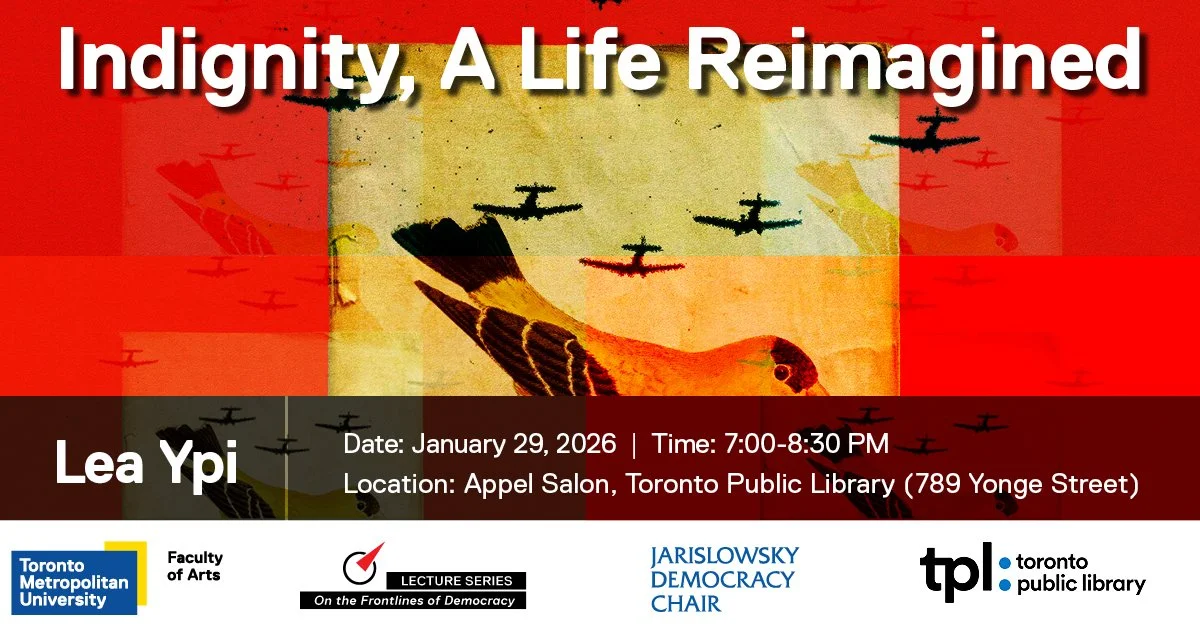
War, rising nationalism and the movement of peoples are defining features of our era, reshaping the political landscape and challenging democratic institutions worldwide.
What does this historical resonance mean for modern European politics? How do the ghosts of the 20th century, its ideological battles and refugee crises, its cycles of hope and disillusionment, continue to haunt its democracies? As Europe once again confronts questions of borders, national identity and belonging, what lessons can we draw from those who lived through similar convulsions generations ago?
Drawing from her experience growing up in one of Europe’s most isolated regimes and family history, and scholarly work on freedom, citizenship, and political transformation, the acclaimed political philosopher Lea Ypi offers crucial insights into how regimes shape lives across generations, democracy’s fragility and what it means to sustain human dignity amid profound uncertainty.
In conversation with Sanjay Ruparelia at the Toronto Reference Library's Appel Salon.
About the speaker: Lea Ypi is Ralph Miliband Professor of Politics and Philosophy at the London School of Economics and Political Science and a Fellow of the British Academy. She is also Honorary Professor of Philosophy at the Australian National University, a Permanent Fellow of the Wissenschaftskolleg zu Berlin and a fellow of Academia Europea and of the Albanian Academy of Science. Born and raised in Albania, she studied Philosophy and Literature at the University of Rome La Sapienza, earned a PhD from the European University Institute and was a Post-Doctoral Prize Research Fellow at Nuffield College, Oxford. She is the author of Global Justice and Avant-Garde Political Agency, The Meaning of Partisanship (with Jonathan White), and The Architectonic of Reason, all published by Oxford University Press. Her philosophical memoir, Free: Coming of Age at the End of History (Penguin Press in the UK; W.W. Norton & Company in North America), won the 2022 Royal Society of Literature Ondaatje Prize and the Slightly Foxed First Biography Prize, and is translated in more than thirty-five languages. Her academic work has been recognised with the British Academy Prize for Excellence in Political Science and the Leverhulme Prize for Outstanding Research Achievement. She coedits the journal Political Philosophy and occasionally writes for The Guardian and Financial Times. Her latest book is Indignity : a life reimagined.
About the discussant: Sanjay Ruparelia is Professor of Politics and Public Administration at Toronto Metropolitan University, where he holds the Jarislowsky Democracy Chair, and a Senior Fellow of the Asia Pacific Foundation of Canada. His main publications include Divided We Govern: Coalition Politics in Modern India; The Indian Ideology, and Understanding India’s New Political Economy. His research has been supported by grants and fellowships from the Commonwealth Foundation, American Council of Learned Societies and Social Science and Humanities Research Council as well as Cambridge, Johns Hopkins, New School, Notre Dame, Princeton, Stellenbosch and Yale. Sanjay serves as a co-chair of Participedia, which studies democratic innovations globally, and on the editorial boards of Indian Politics and Policy and Pacific Affairs. He hosts On the Frontlines of Democracy, a monthly podcast and lecture series, and regularly contributes to media in Asia and North America, including the CBC, CTV, Channel News Asia, Globe and Mail, Hill Times, Hindustan Times, Indian Express, New York Times, The Hindu, The Walrus, Toronto Star and Washington Post. Sanjay previously taught at the New School for Social Research and Columbia University. He earned a B.A. in Political Science from McGill University, and a M.Phil in Sociology and Politics of Development and Ph.D. in Politics from the University of Cambridge.
About the series:
On the Frontlines of Democracy is a public lecture and podcast series to analyze the prospects of democracy in the twenty-first century. Around the world, democracy faces serious challenges, old and new. Can we protect individual rights and the rule of law in an era of popular mistrust, severe partisanship and resurgent nationalism? How can our democracies reduce inequalities of power, wealth and status, defend deep diversity and confront climate change in the new digital age? Can we develop innovative strategies to revitalize civic engagement, empower public institutions and resist autocratic threats? How can we support the expansion of democracy, in an evolving post-western order, without committing the mistakes of the past?